Methodology · The 0–100 verdict
How your compatibility score is calculated
Yuka and INCI Beauty give everyone the same grade. MyGlowApp calculates its score for your skin type, your concerns and your goals. Here is, without hype, what it looks at, how much each part weighs, and why the same serum can be "Recommended" for one skin and "Better avoid it" for another.
The formula
Five questions, one number
Every product is assessed in five blocks, each from 0 to 5. The blocks carry fixed weights (the same for everyone) and the result is converted into a 0–100 score. What changes from person to person is not the weights: it is the answers, because three of the five blocks depend on your profile.
Safety 25%Your concerns 25%Your skin type 20%Your goals 15%Formulation 15%
Ingredient safety · 25%
Irritants, drying alcohols, fragrance, comedogenics, strong actives and where each one sits in the INCI list. Together with the next block it weighs the most, and it is the only one that can sink the score on its own (see below).
Fit with your concerns · 25%
Acne, redness, dark spots, dehydration, pores, wrinkles… does the formula help with what you want to fix, do nothing, or make it worse? A strong exfoliant scores for pores and texture, and loses points for redness.
Match with your skin type · 20%
Oily, dry, combination, normal or sensitive. Heavy butters and oils lose points on oily skin; fragrance and alcohols lose points on sensitive skin; a base that is too light loses points on dry skin.
Alignment with your goals · 15%
Glow, texture, hydration, anti-aging… whatever you set in your profile. A product can be safe and still not move you towards your goal: then it scores little here.
Formulation quality · 15%
How coherent the formula is: whether the actives sit high enough in the list to do anything, whether the vehicle makes sense for that active, and whether the combination is consistent rather than a cocktail of claims.
The result
A weighted average from 0 to 5, converted to 0–100 and rounded. An average of 4 gives 80; 3 gives 60; 2 gives 40. That is why the bands cut exactly at those numbers.
The bands
What each color means
The score sets the band. The same four bands apply in the app, on this site and on our social channels.
Recommended for you
Ingredients aligned with your skin type, your concerns and your goals. Add it to your routine with one tap.
Good option
It suits you where it matters; there may be a nuance (a texture, a secondary active) that the app explains.
Use with caution
Contains an ingredient that may not agree with you, or a safety rule has capped the score. We tell you which one and why.
Better avoid it
Comedogenic or irritating for your profile. The AI suggests an alternative that fits you.
Safety rules
The score can only go down, never up
On top of the formula sit fixed rules that the AI does not decide. When one fires, it caps the score and the verdict, and the app tells you which rule and why.
Very low safety
If the safety block comes out at 1 or 2 out of 5, the verdict stays at "Use with caution" or "Better avoid it" even if the other four blocks are excellent.
Body products on the face
Body lotions, hand creams or petroleum jelly assessed for facial use: capped at 55 and never above "Use with caution".
Tanning and sun-exposure oils
Products meant for unprotected sun exposure: never above "Use with caution", and "Better avoid it" (capped at 20) if your profile includes dark spots or sensitive skin.
High fragrance on sensitive skin
If your skin is sensitive or redness-prone and fragrance or irritant essential oils sit in the top half of the list: capped at 55 and "Use with caution".
The cautious one wins
When the number and the verdict disagree, the more conservative one rules. A 61 is never shown as "Recommended", and an 85 with a safety warning keeps the warning.
Always with a reason
Every cap leaves a visible reason in the analysis: which rule fired and which signal triggered it. No scores that drop without explanation.
Confidence
When the label can't be read well
The score is only as good as the list that feeds it. So when the photo isn't enough, the app would rather fall short than make things up.
Conservative mode
If the list could not be cross-checked against a verified source, the safety and formulation blocks are capped at 3 out of 5. If, on top of that, very few ingredients were read or the photo is doubtful, confidence is flagged as low and the final score is reduced by 5%.
What you can do
Good light, a flat label and the full INCI list inside the frame. Retaking the photo usually raises confidence, and with it the precision of the score.
What the score doesn't do
It doesn't measure exact concentrations (labels don't disclose them: it uses the order of the list), it doesn't diagnose, and it doesn't replace your dermatologist. It helps you decide better in the store and in your bathroom.
An example
Same product, three skins
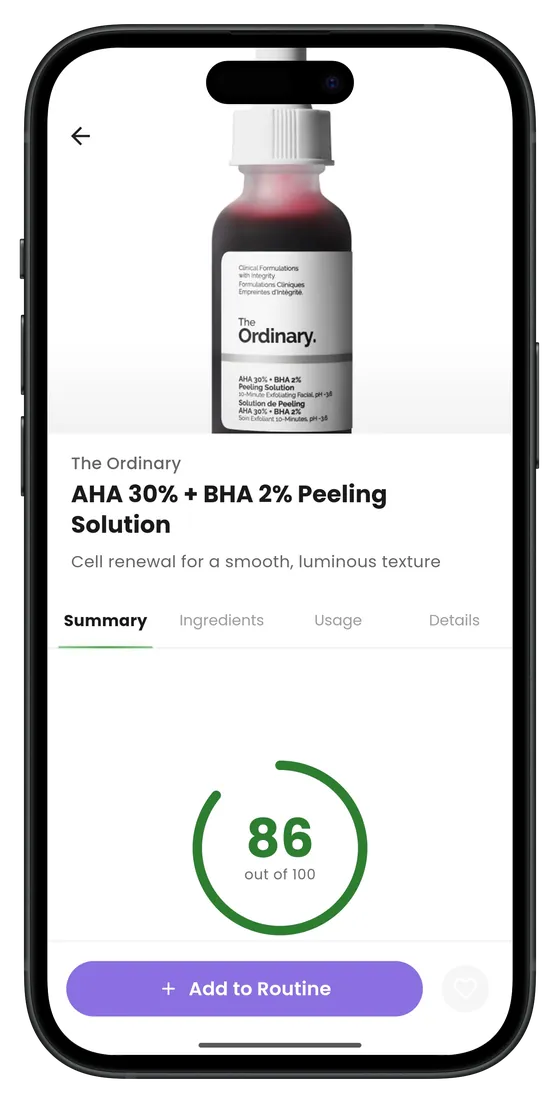
An exfoliant with AHA 30% + BHA 2%, like the one in the screenshots on this site. The ingredients don't change; the profile does. An indicative reading of how the blocks respond.
Oily skin, pores and texture
Medium safety (strong acids, but in a rinse-off, few-minutes format), very high on concerns and goals, high on skin type. Green band, with the note to use it once a week and never alongside retinol.
Sensitive, redness-prone skin
Safety drops sharply: high-concentration acids on reactive skin. Here the safety block rules and the verdict stays at caution or "Better avoid it", whatever the other blocks say.
Dry skin, hydration goal
Tolerable in moderation, but it doesn't move you towards the goal and may dry the skin further. Middle score: it usually lands in the caution band, with a hydrating alternative suggested.
Want to see it with your own products? Photograph the label and you'll have the score, with its reasons, in seconds.
Frequently asked questions
Because three of the five blocks (your concerns, your skin type and your goals, 60% of the score) are calculated against your profile. The ingredients are the same; the question "is it for me?" is not.
That the score is between 40 and 59, or that a safety rule has capped it there. It is not a "no": it usually points to a specific ingredient to watch, a lower frequency of use or a step in your routine to adjust. The app tells you which.
Saved analyses keep the score they were given. If you change your skin type, concerns or goals, scan the product again and it is recalculated with the new profile.
The score measures the product against your profile. Separately, when you add it to your routine the app checks for conflicts with what you already use (two strong exfoliants, retinol and acids on the same night…) and suggests how to fit it in or what to replace.
No. Those apps give a generic hazard score, the same for everyone. MyGlowApp's is a compatibility score for you: it includes safety, but the remaining 60% depends on your skin. A safe product can be a poor choice for you, and the other way round.
No. You photograph the INCI list and the AI reads it: it works with any brand, including pharmacy and drugstore brands that are missing from catalogs. If the photo can't be read well, the app tells you and you retake it.
MyGlowApp
Try it with what's already in your bathroom
Scan your first products free and see the score with its reasons, for your skin.
Free for 7 days · then $34.99/year (shown in your local currency in the store)
4.7 ★ store rating✦No commitment✦GDPR✦Made in Europe