Salicylic acid: what it does and whether it suits your skin
Salicylic acid is skincare’s BHA, the pore acid. Here’s which skin the app looks for it in, what it combines with and how much a product can contain in Europe.
On an ingredient list it appears as “Salicylic Acid”. It’s oil-soluble, which is why it’s linked to pores. For the app it’s a strong active: it helps with pores, breakouts and shine, it only counts if it sits high on the list, and it never goes on the same night as another strong active.
— 01
Why the app looks for it
For visible pores, breakouts and shine. It’s one of the three ingredients the app looks for first for oily skin.
— 02
Its EU limit
Up to 2% in skin products (0.5% in body lotions, eye makeup, lip products and roll-on deodorants), and it isn’t allowed in products for children under 3.
— 03
In a cleanser
The app never treats a cleanser as “strong”: it rinses off in seconds. Where it calls for care is in what stays on your skin.
What you can mix it with
The app’s rule: one strong active per night
The app only keeps strong actives apart, because on the same night they add up. Everything else combines.
Yes. Niacinamide isn’t a strong active and the app doesn’t keep them apart. What doesn’t go on the same night is salicylic acid with another strong active: retinoids, AHAs or benzoyl peroxide.
Yes: the app looks for it for oily skin and for breakouts and visible pores. If your skin is sensitive, it marks it as something to avoid.
In the European Union, up to 2% in skin products, except some (body lotions, eye makeup, lip products, roll-on deodorants), which are capped at 0.5%.
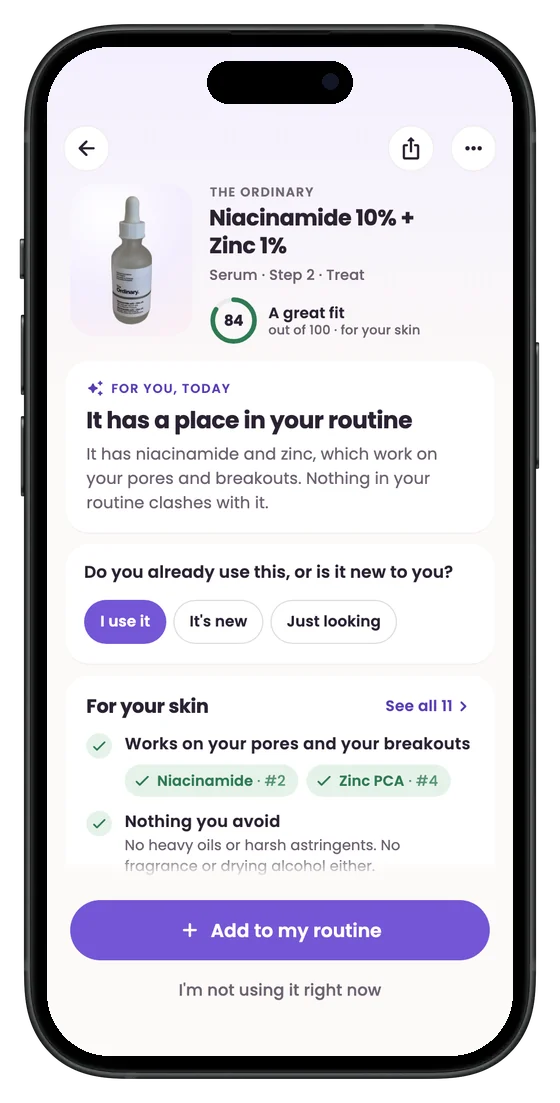
Here you see the score for typical profiles. In MyGlowApp you take a photo of the pack and the score is for your skin type, your concerns and your goals, with the formula sold where you live; and each product slots into its step in your routine.
No barcode needed: a photo of the pack is enough
Your formula’s list, with its source in plain sight
Your morning and night routine with what you already own